When investing in renewable energy, battery storage systems and solar farms are two popular choices. Both address the growing demand for clean energy and the need for reliable power, especially in regions like the UAE and the UK. Here's a quick breakdown:
- Battery storage: Stores surplus energy for use when demand is high or solar generation is low. It's vital for ensuring 24/7 power, especially for energy-intensive operations like data centres. Costs have dropped significantly, with systems priced around AED 460/kWh in 2025, and the Levelised Cost of Storage (LCOS) at AED 240/MWh.
- Solar farms: Generate large-scale, low-cost renewable energy. In the UAE, solar farms have achieved some of the world's lowest energy prices at AED 51/MWh. They are often paired with battery systems for continuous energy supply.
Quick Comparison
| Factor | Battery Storage | Solar Farms |
|---|---|---|
| Capital Costs | High: AED 460/kWh | Low: AED 51/MWh (UAE, 2025) |
| ROI | 8-year payback period | 5–10 years payback period |
| Scalability | Modular, compact | Requires significant land |
| Regional Alignment | Supports 24/7 energy needs | Key to renewable energy targets |
Both technologies complement each other. For example, the UAE's Masdar-EWEC project integrates 5.2 GW of solar capacity with 19 GWh of battery storage, delivering 1 GW of continuous power by 2027.
Investors should consider their goals: battery storage ensures reliability and grid stability, while solar farms offer cost-effective bulk energy generation.
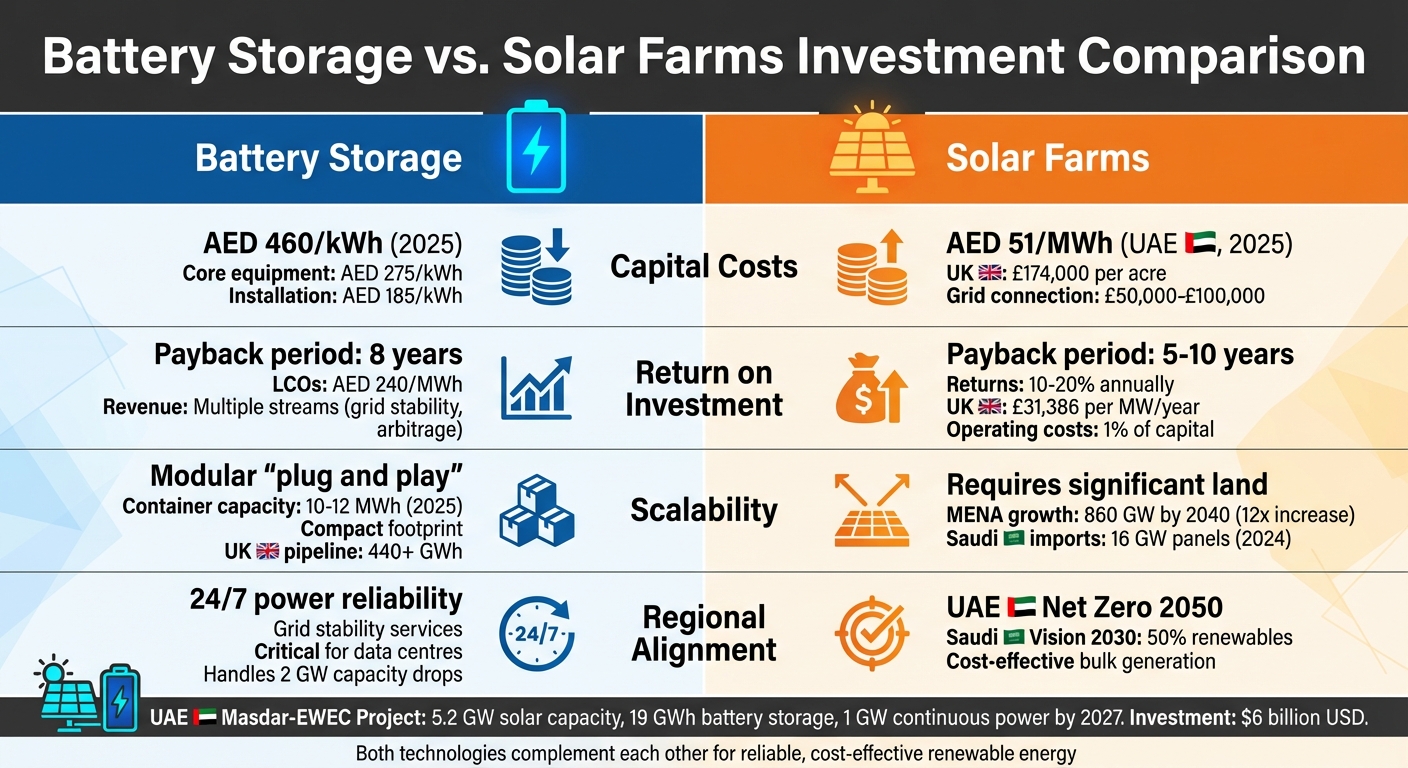
Battery Storage vs Solar Farms Investment Comparison: Costs, ROI, and Scalability
1. Battery Storage Systems
Capital Costs
Battery energy storage systems are becoming more affordable, making them a viable option for large projects. As of October 2025, the total capital cost for utility-scale battery energy storage systems (BESS) with long-duration capabilities (4+ hours) is around AED 460/kWh in markets outside China and the US. Notably, recent projects in Saudi Arabia have achieved costs as low as AED 440/kWh. Breaking this down, core equipment - mainly sourced from China - accounts for about AED 275/kWh, while installation and grid connection contribute approximately AED 185/kWh.
The cost of battery equipment alone saw a sharp decline, dropping by 40% in 2024 and continuing into 2025. For instance, Saudi Electricity Company secured contracts in August 2025 for its Tabuk and Hail projects at rates ranging from AED 268–AED 275/kWh for 2.45 GWh systems, with additional engineering and construction costs of AED 173–AED 176/kWh.
Return on Investment
The financial appeal of battery storage has improved significantly. Lithium Iron Phosphate (LFP) batteries now come with a standard lifespan of 20 years, allowing the initial investment to be spread over a longer period, enhancing overall returns. Furthermore, the Levelised Cost of Storage (LCOS) has dropped to approximately AED 240/MWh.
While solar power remains the cheapest energy source at around AED 158/MWh, integrating storage to shift 50% of daytime energy to nighttime use adds roughly AED 121/MWh, bringing the total cost of dispatchable solar energy to about AED 279/MWh. As Kostantsa Rangelova, a Global Electricity Analyst at Ember, explains:
"Solar is no longer just cheap daytime electricity, solar is now anytime dispatchable electricity. This is a game-changer for countries with fast-growing demand and strong solar resources."
Scalability
Battery storage systems are designed for efficient scalability, thanks to modular "plug and play" setups that streamline deployment and lower project risks. Technological advancements have also significantly increased storage capacity. For example, the energy capacity of standard 20-foot shipping containers has doubled - from 5–6 MWh in 2024 to 10–12 MWh in 2025.
Scalability is further supported by "revenue stacking", which allows projects to generate income from multiple streams, including energy arbitrage, capacity markets, and grid stability services. In the UK, this approach has led to a diversification of revenue sources. By early 2024, ancillary services accounted for only 20% of revenues - down from 84% in 2022 - as operators expanded their income strategies.
Alignment with Regional Goals
Battery energy storage systems are essential for meeting the UAE's Net Zero 2050 goals and supporting broader efforts to reduce carbon emissions. Large-scale projects in the Middle East, such as AI-driven data centres, rely heavily on BESS to handle sudden capacity drops - up to 2 GW - caused by factors like cloud cover.
Reflecting its commitment to renewable energy, the Emirates Water and Electricity Company issued a tender in July 2024 for a 400 MW battery storage contract to aid renewable integration. Similarly, Saudi Arabia has launched tenders for 2,500 MW of battery capacity. In the UK, the battery storage pipeline has grown to over 440 GWh, supported by innovative market frameworks and new legislation that classifies BESS as a generation asset, simplifying construction requirements.
Next, we’ll explore solar farms to round out this comparison of investment opportunities.
sbb-itb-0a9f22b
2. Solar Farms
Capital Costs
When it comes to costs, solar farms have a unique financial structure compared to battery storage. In the UK, establishing a 1-acre solar farm costs approximately £174,000, with the bulk of this - around £165,000 - going towards equipment and infrastructure. Additionally, grid connection fees typically range between £50,000 and £100,000 per acre, accounting for 10–15% of the upfront investment.
In the Middle East, conditions are highly favourable for large-scale solar projects. For instance, in May 2025, Masdar and Emirates Water and Electricity Company began work on a massive US$6 billion (around AED 22 billion) project in the UAE. This facility, set to combine 5.2 GW of solar PV capacity with 19 GWh of battery storage, is expected to supply 1 GW of continuous renewable energy by 2027. Similarly, in Egypt, Norwegian energy company Scatec signed a power purchase agreement in January 2026 for a 1.95 GW solar PV plant integrated with 3.9 GWh of battery storage. These projects underline the financial potential of solar farms in the region.
Return on Investment
In the UK, solar farms generate approximately £31,386 per MW annually, offering investors returns of 10–20%. Most projects recoup their initial costs within 5–10 years. Operating expenses are minimal, averaging just 1% of the initial capital investment each year, thanks to the low-maintenance nature of solar technology compared to other renewable energy systems.
Globally, the average price of solar energy was AED 158/MWh in 2024. This competitive pricing makes solar-plus-storage solutions an attractive option for investors looking for steady, long-term returns while contributing to regional clean energy goals.
Scalability
The scalability of solar farms further boosts their appeal as an investment. In the Middle East and North Africa (MENA) region, solar capacity is projected to grow significantly, with 860 GW of new solar PV installations expected by 2040 - a 12-fold increase from 2024 levels. For perspective, Saudi Arabia imported 16 GW of solar panels in 2024, more than doubling its imports from the previous year.
While grid limitations pose challenges in Europe, the MENA region remains largely unaffected. By 2035, grid constraints are anticipated to reduce solar capacity in Europe by 16%, whereas the MENA region is expected to maintain uninterrupted growth. Jan Zschommler, Market Area Manager for Middle East & Africa at DNV, highlights this shift:
"The Gulf is moving from discussion to deployment. Utility-scale solar, wind, and storage projects are now being built at a pace that changes the regional power mix."
Alignment with Regional Goals
Solar farms also align seamlessly with the renewable energy ambitions of the region. They form a cornerstone of the UAE's Net Zero 2050 strategy and Saudi Arabia's Vision 2030, which aims to generate 50% of domestic power from renewable sources by 2030. Masdar, for example, has set a goal of achieving 100 GW of clean energy capacity by 2030.
The growing demand for solar-plus-storage solutions is also being driven by data centres and AI facilities, which require round-the-clock power. To meet this need, solar farms are increasingly being paired with battery systems. In early 2025, ACWA Power and Bapco Energies announced a joint development agreement to build a 2.8 GW solar PV plant with integrated battery storage in Saudi Arabia, supporting the country's move away from hydrocarbons for domestic energy needs.
Advantages and Disadvantages
When comparing battery storage with solar farms, investors face several factors that influence both returns and strategic alignment. Each technology presents distinct benefits and challenges, shaped by market trends and regional needs.
Battery storage has become increasingly attractive due to its improving cost structure. By October 2025, all-in capital costs are expected to drop to around AED 460/kWh, with the Levelised Cost of Storage (LCOS) reaching AED 240/MWh. This brings the cost of dispatchable solar energy to approximately AED 279/MWh.
On the other hand, solar farms continue to dominate in terms of low-cost bulk energy generation. In the Middle East, record-breaking Power Purchase Agreement (PPA) prices were achieved in 2025, with Saudi Arabia securing rates as low as AED 47/MWh and the UAE at AED 51/MWh. These figures are significantly below the region's gas-fired generation costs, which range between AED 165–AED 169/MWh.
Here’s a breakdown of the key trade-offs between the two options:
| Factor | Battery Storage | Solar Farms |
|---|---|---|
| Capital Costs | Higher upfront costs at AED 460/kWh; core equipment priced at AED 275/kWh, with installation adding AED 185/kWh | Lower initial costs due to declining panel prices; for instance, a 1-acre solar farm in the UK costs approximately £174,000 |
| ROI | Generates revenue through grid stability services, frequency control, and capacity auctions; payback period of about 8 years | Provides steady income through long-term PPAs; payback periods range from 5 to 10 years |
| Scalability | Highly modular and adaptable; 20-foot containerised units can store 5–10 MWh; easily co-located with existing plants | Requires significant land, often flat or south-facing; MENA region expects an additional 860 GW of solar capacity by 2040 |
| Regional Alignment | Critical for stabilising grids and supporting intermittent renewable energy sources; ensures 24/7 power reliability, especially for data centres | Plays a key role in meeting renewable energy targets, such as the UAE’s aim for 50% renewables by 2050 and Saudi Vision 2030 |
The rapid decline in battery prices is reshaping investment decisions across the Middle East. For instance, recent projects in Saudi Arabia have achieved total project costs of around AED 440/kWh. These trends are enabling investors to align their portfolios with the region’s broader goals of decarbonisation and energy stability, paving the way for a more sustainable energy future.
Conclusion
When it comes to energy investments, the choice often depends on addressing specific challenges. Solar farms are a go-to solution for cost-efficient bulk energy generation, particularly in the Middle East. They provide predictable financial returns through long-term contracts and come with simpler operational demands. On the other hand, battery storage systems are indispensable for ensuring grid stability, meeting the needs of data centres, and delivering renewable energy consistently, 24/7.
A standout example of this synergy is the UAE's ambitious project by Masdar and Emirates Water and Electricity Company. This initiative combines a massive 5.2 GW solar plant with a 19 GWh battery energy storage system to supply 1 GW of baseload power. As Mohamed Jameel Al Ramahi, CEO of Masdar, aptly described it:
"a blueprint for the world, demonstrating that renewable energy can be dispatched around the clock".
This project highlights how battery storage transforms intermittent solar power into a reliable, dispatchable energy source. Co-located solar and battery systems are particularly effective, ensuring a steady "firm volume" of energy supply essential for uninterrupted operations.
Investment strategies must adapt to regional dynamics and market maturity. In the Middle East, large-scale integrated projects using capacity-based payment models and AI-driven forecasting are key to maximising returns. Meanwhile, in the UK, the focus is shifting toward battery storage investments that support grid-balancing services and capacity auctions, with the storage pipeline already surpassing 440 GWh. While UK solar farms continue to deliver consistent returns of 10–20%, integrating storage is becoming increasingly crucial to address curtailment risks.
FAQs
What financial advantages can battery storage bring to solar farms in the UAE?
Integrating battery storage with solar farms is a game-changer for energy management. It allows surplus energy generated during the day to be stored and used at night, cutting down on wastage and boosting profitability. This approach not only improves revenue but also enhances the overall return on investment (ROI). For example, shifting about half of daily solar production to nighttime use could cost roughly AED 121 per MWh, leading to a competitive levelised cost of storage of around AED 239 per MWh.
Additionally, this strategy significantly reduces energy curtailment, supports the UAE's renewable energy objectives, and capitalises on the decreasing costs of large-scale storage systems. With utility-scale storage prices projected to drop by 50–60% by 2030, battery storage emerges as a smart investment for maximising the efficiency and profitability of solar farms.
How do renewable energy goals in the UAE and UK shape investment strategies in solar and battery storage?
Renewable energy targets in both the UAE and the UK are shaping the landscape for investments in solar farms and battery storage systems. In the UAE, the government’s Net Zero by 2050 strategy, combined with its push for economic diversification, has spurred significant momentum in large-scale solar and energy storage projects. These initiatives are key to managing the variability of solar power, ensuring grid stability, and addressing the region’s rising energy demands. Investors are particularly interested in projects offering firm capacity, measured in megawatts (MW) and megawatt-hours (MWh), with pricing typically expressed in AED per kilowatt-hour (kWh).
Meanwhile, the UK’s legally binding Net Zero by 2050 commitment is backed by a well-defined regulatory framework, which helps minimise risks for investors. Mechanisms like Ofgem’s cap-and-floor policy provide clear cost assessment guidelines, making battery storage investments more straightforward. The UK’s emphasis on grid reliability and its drive for decarbonisation further enhance its attractiveness as a hub for renewable energy ventures. Investors often focus on projects that align with these frameworks, aiming to achieve strong returns while supporting broader sustainability objectives.
What should investors evaluate when deciding between battery storage and solar farms in the UAE and UK markets?
When deciding between utility-scale battery energy storage systems (BESS) and solar farms, investors need to weigh factors like costs, scalability, and revenue potential. In the UAE, battery projects typically cost around AED 460 per kWh of storage capacity, with a levelised cost of storage (LCOS) close to AED 240 per MWh. In contrast, solar farms are evaluated using their levelised cost of electricity (LCOE), which has been steadily dropping over time. Comparing the capital costs per MW for solar farms with the cost per kWh for batteries, as well as assessing revenue streams such as power purchase agreements or grid services, is a crucial step.
Batteries bring flexibility to the table by stabilising the grid, storing solar energy for later use, and addressing fluctuating energy demands. Solar farms, while more consistent in their energy generation patterns, rely on sunlight and often require additional storage to ensure a continuous power supply. Regional factors, such as the UAE’s renewable energy goals and incentives, also play a significant role in decision-making. Additionally, investors should consider the lifespan of these assets - solar panels generally last 20–30 years, while many battery systems have a lifespan of 10–15 years.
For industries like data centres, which demand reliable, on-demand energy, tailoring investments to meet specific energy needs can significantly enhance portfolio performance. Balancing these considerations allows investors to align their strategies with both market demands and long-term sustainability goals.