Securing funding for renewable energy projects can be challenging, but following a clear roadmap simplifies the process. Here's a quick guide to help you overcome financial hurdles and bring your solar or wind project to life:
- Market and Feasibility Analysis: Assess site potential, regulatory requirements, and create financial models to prove viability.
- Technical Proposal: Develop a detailed project plan, including design, implementation, and risk management strategies.
- Government Incentives: Tap into UAE and UK schemes like the UAE Energy Strategy 2050 or the UK’s CfD programme for financial support.
- Investor Engagement: Partner with knowledgeable investors who understand local markets and regulatory frameworks.
- Public-Private Partnerships (PPPs): Share risks and responsibilities through structured agreements with public entities.
- Financial Models and Debt Financing: Build robust financial models (e.g., LCOE) and explore funding options like green bonds or Islamic finance.
- Contracts and Financial Close: Finalise PPAs and EPC agreements to secure funds and begin construction.
Key takeaway: Align your project with national goals (e.g., UAE’s Net Zero 2050 or UK’s renewable targets) and present a strong financial case to attract both public and private funding.
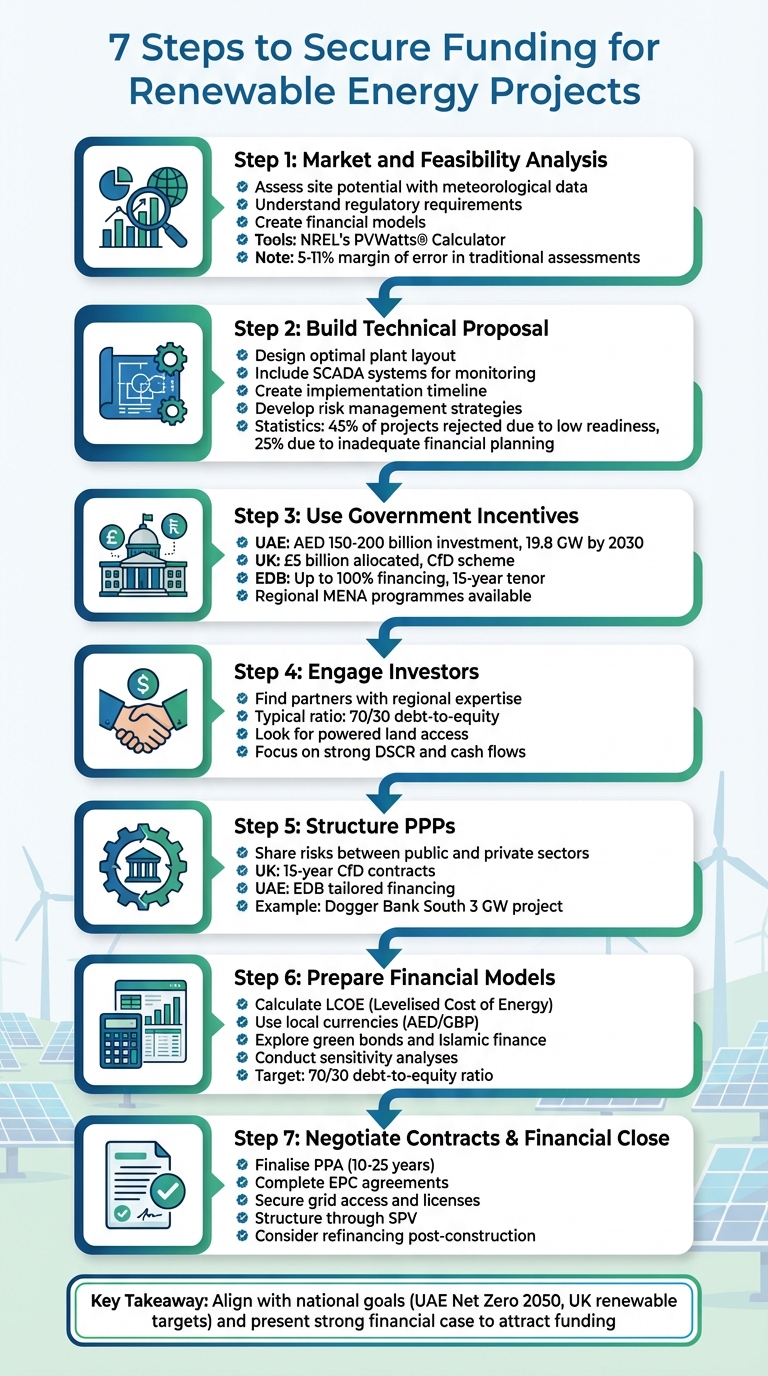
7-Step Process to Secure Renewable Energy Project Funding
Renewable Energy Project Finance Basics with Josh Pearson ’97
sbb-itb-0a9f22b
Step 1: Conduct Market and Feasibility Analysis
Before seeking investment, you need solid data to prove your project is viable. This involves assessing the renewable energy potential of your site, understanding relevant regulations, and creating economic models that demonstrate the project’s feasibility. Without these steps, securing funding becomes a steep challenge. This groundwork serves as the backbone for the technical and financial proposals you'll develop later.
Evaluate Project Site Potential
The first step is gathering precise meteorological data for your project location. For instance, a 2010 study in Renewable Energy measured solar radiation in Abu Dhabi (24.43°N, 54.45°E) using a Middleton Solar DN5-E Pyroheliometer. The study recorded a monthly average solar radiation of 493.5 W/m², with a daily peak of 730 W/m² and a one-minute maximum of 937 W/m². These findings were cross-checked with long-term NASA data for accuracy.
For a practical energy production estimate, tools like NREL's PVWatts® Calculator can be invaluable. By entering site-specific details - such as solar resource, panel tilt, and azimuth - you can calculate potential energy output. To improve accuracy, combine satellite data with ground-level measurements, keeping in mind that traditional assessments often carry a 5%–11% margin of error. Environmental conditions also play a role: dust accumulation in some regions can reduce yearly energy output by up to 7%, while snow in colder climates could lead to losses of up to 15%. Simple adjustments, like reorienting solar panels twice a year, can increase energy production by 3% to 4.8%. Reliable site data not only strengthens your feasibility study but also ensures compliance with local energy regulations.
Align with Regulatory and Policy Requirements
Your feasibility study must align with national energy goals. In the UAE, projects should support the UAE Net Zero 2050 strategy, which emphasises renewable energy and energy efficiency. The Emirates Development Bank (EDB) plays a key role here, offering CAPEX financing for solar panels and structured funding for greenfield wind and solar farms.
In the UK, compliance revolves around the Contracts for Difference (CfD) scheme, the main policy for encouraging renewable energy development. For example, in October 2025, the UK Department for Energy Security and Net Zero (DESNZ) partnered with Arup to update cost and technical benchmarks for onshore wind and large-scale solar PV (over 5MW). This research influenced strike prices in CfD Allocation Round 7, affecting how developers plan revenues and assess project feasibility.
Planning thresholds can also impact your project. In England, solar PV projects over 100MW and onshore wind projects over 100MW are subject to the Nationally Significant Infrastructure Project (NSIP) regime. In Wales, the threshold for most renewable projects is 350MW. For UK projects with a capacity of 300MW or more, you must submit a Supply Chain Plan addressing areas like green growth, infrastructure, and skills to qualify for CfD rounds.
Develop Economic Models
When creating financial models, use AED for UAE projects and GBP for UK projects. Compare the investment "strike price" to the market "reference price" to determine CfD support. As DESNZ explains:
"CfDs incentivise investment in renewable energy by providing developers of projects with high upfront costs and long lifetimes with direct protection from volatile wholesale prices".
For UAE projects, incorporate financing options from the Emirates Development Bank, such as CAPEX loans, structured project financing, and receivable finance. The EDB also offers a 3.25% p.a. interest rate on Business Current and Savings Accounts via its EDB 360 app. Use conservative assumptions in your models to reassure investors and account for potential energy yield variations.
| Factor | UAE Context | UK Context |
|---|---|---|
| Primary Resource | High Direct Beam Radiation (up to 937 W/m²) | Onshore Wind and Solar PV (>5MW) |
| Key Policy | UAE Net Zero 2050 | UK Net Zero / CfD Scheme |
| Financing Body | Emirates Development Bank (EDB) | Low Carbon Contracts Company (LCCC) |
| Assessment Tool | NASA SSE Model / Ground Sensors | DESNZ Generation Costs Series |
| Currency for Models | AED | GBP |
Step 2: Build a Technical Project Proposal
After completing your feasibility study, the next crucial step is crafting a technical project proposal. This document bridges the gap between your analysis and securing investment. According to IRENA, 45% of renewable energy projects are rejected due to low readiness, while 25% fail because of inadequate financial planning. A well-prepared proposal addresses these shortcomings and lays out a clear plan for implementation.
Your proposal should build on the findings of your feasibility study and include an optimal plant design tailored to your specific site. This involves selecting the most suitable technology - whether it's photovoltaic panels, wind turbines, or a hybrid system - and creating a layout that maximises energy output. For utility-scale projects, consider incorporating SCADA systems to enable real-time performance monitoring. The World Bank highlights the importance of this step:
"A key project development challenge is to design a PV power plant that is optimally balanced in terms of cost and performance for a specific site".
In addition to the technical design, your proposal must include a detailed project implementation plan. This should cover permits, licences, construction schedules, and budget allocations. Clearly outline your strategy for selecting an EPC contractor and planning long-term operations and maintenance (O&M) to guarantee reliable energy production throughout the project's lifecycle. Standardised contracts, such as Power Purchase Agreements (PPAs) and Installation Agreements, are essential to ensure smooth execution. As noted by the World Bank:
"Power Purchase Agreements (PPAs) specify the terms under which the off-taker purchases the power produced by the PV plant; this is the most important document to obtain financing".
Your proposal should also include a comprehensive risk assessment. Address potential risks - whether technological, construction-related, operational, or regulatory - and outline strategies to mitigate them through insurance and well-structured management plans. Additionally, align your project with Environmental, Social, and Governance (ESG) frameworks and the Sustainable Development Goals (SDGs). This alignment is increasingly important to attract investors who prioritise responsible and sustainable financing. IRENA experts Haliru Audu and Adeline Duclos explain:
"Bankability provides solid evidence that an investment will lead to tangible result and profitability. This concept is critical in bridging the gap between innovative solutions and the financial support they require to materialise".
For projects in the UAE, it’s essential to align with the National Food Security Strategy and the country’s Net Zero goals. Doing so can help you access specialised green financing options, such as those offered by the Emirates Development Bank. Investors often expect an 80/20 debt-to-equity ratio for traditional renewable energy projects, though riskier ventures may require higher equity contributions. To strengthen your proposal, include sensitivity analyses to account for fluctuations in revenue, costs, and cash flow. Protect your financial model against volatility by incorporating measures like currency linkage and inflation adjustments.
Step 3: Use Government Incentives and Subsidies
After solidifying your technical and financial plans, tapping into government incentives can help accelerate funding for renewable energy projects. These incentives play a key role in reducing financial pressures, making clean energy initiatives more feasible. Both the UAE and the UK provide substantial support to drive the transition to sustainable energy, while regional programmes across MENA open up opportunities for cross-border funding. Such incentives effectively bridge the gap between technical potential and financial practicality.
UAE Energy Strategy 2050 and Incentives
The UAE’s Energy Strategy 2050 sets ambitious goals to expand renewable energy’s role in the country’s energy mix. By 2030, the plan aims to triple renewable energy contributions, increasing installed clean energy capacity to 19.8 GW. This vision is backed by government investments ranging between AED 150 billion and AED 200 billion. The strategy also targets a grid emission factor of 0.27 kg CO₂/kWh and aims to create 50,000 new green jobs by the same year.
The Emirates Development Bank (EDB) plays a central role in supporting renewable energy projects. It offers various financing options, including CAPEX finance for solar panels, structured project financing for both new and existing developments, and receivable finance for solar contractors. Abdalla Al Aboodi, Senior Vice President of Project and Corporate Finance at EDB, highlights the bank’s commitment:
"EDB is very bullish about renewable and energy efficiency financing. It can offer finance up to 100 percent of the project value with a maximum tenor of 15 years and a two-year grace period".
Additionally, EDB has a mandate to approve AED 30 billion in financing for 13,500 companies by 2026. To qualify, projects must align with one of EDB’s five strategic pillars and demonstrate both business viability and creditworthiness.
UK Renewable Energy Subsidies and Funds
In the UK, government programmes have allocated nearly £5 billion to help businesses adopt greener practices. The Contracts for Difference (CfD) scheme is a cornerstone of this effort, offering 15-year private law contracts. This system provides a "strike price" that shields developers from fluctuations in wholesale electricity prices, ensuring stable revenue. The CfD scheme uses a sealed bid auction process to allocate funding.
Other initiatives include the Industrial Energy Transformation Fund (IETF) Phase 2, which provided £70 million for industrial energy efficiency and decarbonisation projects. The Clean Growth Fund supports early-stage clean technology ventures with £20 million, while the Clean Industry Bonus (CIB) offers revenue support to offshore wind projects that invest in sustainable supply chains.
For joint UK–UAE projects, the Gulf Strategy Fund (GSF) offers grants ranging from £80,000 to £150,000 for initiatives lasting three to nine months. Eligible projects must demonstrate strategic alignment, cost-effectiveness, and local demand, particularly in areas like clean hydrogen and carbon capture. Proposals must also show a strong connection to the UAE, either through an existing presence or established partnerships. Applicants can begin by submitting a concept note to refine their proposals.
MENA Regional Programmes
Beyond national-level initiatives, MENA-wide programmes offer additional opportunities for renewable energy projects. These efforts often focus on emerging technologies like green hydrogen, carbon capture, and cross-border energy infrastructure. To qualify, projects typically need to demonstrate multilateral partnerships and the ability to operate across different jurisdictions. Highlighting how your project contributes to regional energy security and economic diversification - aligned with Gulf Cooperation Council (GCC) objectives - can significantly boost your chances of securing funding. Incorporating these regional programmes into your strategy not only strengthens your proposal but also enhances its appeal to cross-border investors.
Step 4: Engage Investors Like Gamcap
After securing government incentives, the next step is to find an investment partner who understands the renewable energy landscape in both the UAE and the UK. Many investors lack the expertise to navigate the complex regulatory, financial, and infrastructure challenges in these markets. Choosing a partner with regional knowledge and technical skills can make a huge difference in speeding up your project's financial close. Focus on evaluating investors who combine industry expertise with a strong approach to risk management.
Find the Right Investment Partner
The right investor offers more than just funding - they bring essential technical knowledge, experience in your target market, and the ability to handle complicated processes like permitting and grid connections. Look for partners who have a solid track record in your specific technology, whether it’s solar PV or wind energy, and who understand the local regulatory frameworks. For instance, an investor familiar with the UK's Contracts for Difference (CfD) scheme or the UAE's Energy Strategy 2050 will know how to structure deals that align with national goals and regulations.
It's also important to define the investor's role in your project's financial structure. Equity investors are typically involved in the early, riskier stages, while debt financing - such as loans from Emirates Development Bank - becomes more relevant once risks are mitigated. In mature renewable energy markets, a 70/30 debt-to-equity ratio is common, often supported by long-term Power Purchase Agreements (PPAs).
Additionally, consider investors with access to powered land - sites already equipped with essential energy infrastructure. These locations can significantly shorten project timelines, which is a key advantage in markets like the Middle East and the UK. This is especially relevant as some regions may need to expand their grid infrastructure by over 150% by 2050.
Gamcap's Role in Renewable Energy Investments
Once you’ve identified the qualities of an ideal investor, it’s worth exploring how specialised partners like Gamcap can meet these needs.
Gamcap focuses on powered land development, securing strategic sites and integrating energy infrastructure before institutional capital is brought in. With over 12 years of experience, Gamcap has handled transactions worth more than £500 million and manages a development pipeline exceeding 2GW.
The company operates through three main channels:
- In-house developments: Taking projects from the earliest stages to a "ready-to-build" or operational state.
- Mergers and acquisitions (M&A): Acquiring assets developed by third parties at various stages before they become operational.
- Joint ventures: Partnering with local entities to co-develop or acquire portfolios of assets.
This flexible approach is particularly useful in regions like the Middle East and the UK, where joint ventures can blend local market expertise with technical and financial strengths.
Gamcap’s portfolio highlights its collaborative efforts, including partnerships with Gas Power Developments and Orsted on flexible gas peaking plants in the UK, as well as working with Magnora ASA on solar PV and Battery Energy Storage Systems. Chris Isard, Operations Director at Gamcap, emphasised their team-oriented strategy:
"As we continue to grow our portfolio, we look forward to working closely with DONG Energy and our strategic partners to deliver maximum value from these assets".
For developers seeking funding, engaging with specialised investors like Gamcap early in the project lifecycle can be a game-changer. Their expertise in securing land and power infrastructure can add significant value before institutional capital comes into play. As Gamcap explains:
"A significant portion of value will be created upstream - at the point where land is secured, power is enabled, and projects are originated well before institutional capital is deployed".
When pitching your project, ensure your business plan highlights strong Debt Service Coverage Ratios (DSCRs) and predictable cash flows. Tailor your proposal to align with regional goals, such as the UAE’s Net Zero ambitions or the UK’s target of achieving 45–47 GW of solar capacity by 2030. Using standardised documentation for PPAs and O&M agreements can help cut transaction costs and speed up the review process. Additionally, sensitivity analyses can demonstrate how your project will hold up against changes in interest rates and energy prices.
Step 5: Structure Public-Private Partnerships (PPPs)
Once you've secured the right investment partner, the next step is formalising your collaboration through a well-thought-out Public-Private Partnership (PPP). By combining public and private sector strengths, a PPP not only secures financing but also helps distribute risks more effectively. According to the World Bank, a PPP is a long-term agreement where both risk and management responsibilities are shared between a private partner and the government.
PPP Models for Solar and Wind Projects
One of the most recognised PPP frameworks for renewable energy is the UK's Contracts for Difference (CfD) scheme. Under this model, developers enter into a 15-year strike-price contract with the government-owned Low Carbon Contracts Company (LCCC). This guarantees a fixed electricity price, shielding developers from market price volatility. For instance, on 14 January 2026, the UK's Department for Energy Security and Net Zero announced the results of Allocation Round 7 (AR7), underscoring the government's dedication to advancing renewable energy through competitive annual auctions.
In the UAE, the Emirates Development Bank (EDB) plays a key role in supporting renewable energy projects. It provides tailored project financing for both Greenfield and Brownfield sites, along with CAPEX financing for solar installations. Additionally, EDB offers receivable finance solutions to approved solar contractors, helping them manage cash flow while awaiting customer payments. This approach aligns with the UAE Energy Strategy 2050, easing financial challenges for developers while supporting national energy goals.
A notable example is the Dogger Bank South offshore wind project in the UK. Masdar acquired a 49% stake in RWE's 3 GW project, where RWE takes charge of development and Masdar co-invests. The first 800 MW is set to go live in 2029, eventually powering 3 million homes. This partnership model highlights the importance of assigning technical and operational responsibilities to the most experienced partner while sharing financial risks. These structured agreements lay the groundwork for defining revenue-sharing terms and risk allocation, two essential components of a successful PPP.
Revenue Sharing and Risk Allocation
The success of any PPP relies heavily on clear risk allocation - assigning each risk to the party best equipped to handle it. For example, in the UK's CfD model, the government assumes market and price risks by guaranteeing a strike price, while private developers manage construction and operational risks. In the Middle East, risk-sharing often involves blended finance arrangements and support from sovereign wealth funds. As Brian Kolek from Renewables In Africa explains:
"Public-private partnerships, blended finance schemes, and risk-sharing mechanisms enable Emirati firms to mitigate volatility while maximising project bankability".
Between 2019 and 2023, the UAE invested US$110 billion in Africa, with US$72 billion specifically allocated to renewable energy projects.
Revenue-sharing agreements should be carefully aligned with the project's financial structure. In more established markets, hybrid models are common. For instance, governments may provide milestone payments or capital contributions during the construction phase, which are later offset against future availability payments over the contract's duration. In Saudi Arabia, the government reduces demand-side risks with guaranteed off-take agreements, assuring lenders of committed revenue streams. Renewable energy projects often feature a 70/30 debt-to-equity ratio, supported by long-term Power Purchase Agreements (PPAs).
To ensure financial stability, revenue-sharing terms must account for variables like interest rate changes, energy price fluctuations, and potential construction delays. Conducting sensitivity analyses and aligning financing tenor with contract length can help minimise refinancing risks. A great example is Saudi Arabia's Jubail 3B Independent Water Plant, which used "soft mini-perm" loan structures. This approach bridges the gap between long-term contracts and shorter-term commercial bank funding, with built-in incentives for refinancing after a few years of operation.
Step 6: Prepare Financial Models and Secure Debt Financing
Once your PPP framework is established, the next step is to develop detailed financial models that will reassure lenders of your project's feasibility. Most projects rely on non-recourse financing, meaning the debt is repaid solely from the project’s cash flow. Your financial model needs to clearly show that revenues will comfortably meet all financial obligations.
Create Levelised Cost of Energy (LCOE) Models
Using the PPP structure as a foundation, you’ll need to calculate project costs and expected revenues. A central element here is the Levelised Cost of Energy (LCOE). This metric calculates the average cost of electricity generation over the project’s lifespan, factoring in installation costs, operation and maintenance (O&M) expenses, and any regional subsidies.
For example, in the UK, your LCOE model should account for the Contracts for Difference (CfD) scheme. This programme guarantees a 15-year strike price, shielding projects from fluctuations in wholesale electricity prices. In the UAE, your model should include CAPEX financing options and align with the country’s Net Zero 2050 goals. It’s also crucial to build these models in the local currencies - AED (د.إ) for UAE projects and GBP (£) for UK projects - to reflect inflation adjustments and subsidy frameworks accurately.
George Bilicic from Lazard highlights the importance of resilience in renewable energy projects:
"The results of our 2025 analyses underscore the resilience of renewables amid macroeconomic pressures, while emphasizing the critical need for diverse generation portfolios and innovation to meet surging power demands and ensure grid reliability".
Before presenting your financial models to potential lenders, conduct sensitivity tests on variables like interest rates, energy prices, and construction timelines. Lenders will focus on metrics like Debt Service Coverage Ratios (DSCR) and stable cash flow projections. Established markets often support a 70/30 debt-to-equity ratio. However, emerging technologies, such as battery storage, may require a larger equity share.
Explore Financing Options
In addition to conventional bank loans, there are specialised financing tools you can leverage to strengthen your capital structure. Green bonds, for instance, provide access to funds tied to ESG (Environmental, Social, and Governance) standards. In the MENA region, Islamic finance instruments, such as Sukuk and Ijara, offer alternatives that align with Sharia principles while delivering similar economic benefits to traditional loans.
For projects in the UAE, the Emirates Development Bank (EDB) provides tailored solutions. These include CAPEX financing for solar panels and receivable finance to help contractors manage cash flow during the early stages of the project. When structuring Islamic finance in the UAE, you may need to use parallel debt structures to ensure a security agent can claim against providers, as trusts are not always recognised onshore. For construction phases, Istisna’a contracts are particularly useful as they are designed for manufacturing and delivering assets under development.
| Financing Component | UK Market Context | UAE Context |
|---|---|---|
| Primary Subsidy | Contracts for Difference (CfD) | EDB Green Transition Incentives |
| Debt Instruments | Green bonds, Private placements | Islamic finance, CAPEX loans, Receivable finance |
| Lender Focus | 15-year indexed strike prices | Net Zero 2050 strategic alignment |
| Currency | GBP (£) | AED (د.إ) |
Once project risks have been mitigated, refinancing becomes an option, allowing you to reduce long-term debt costs. This step not only secures financial stability but also positions your project for sustainable growth.
Step 7: Negotiate Contracts and Achieve Financial Close
This is the moment where everything comes together - finalising contracts and locking in the funds you need to get construction underway. With financial models validated and debt options secured, this step ensures your project is fully funded and ready to move forward. The focus here is on two key agreements: the Power Purchase Agreement (PPA) and the Engineering, Procurement, and Construction (EPC) contract.
Finalise Power Purchase Agreements
The PPA is your lifeline to stable revenue - it’s what lenders will look at to assess your ability to service debt. These long-term contracts, often lasting 10 to 25 years, outline all the commercial terms for delivering renewable electricity, such as pricing, duration, and delivery methods. If you’re working on a project in the UAE, make sure the terms are set in AED (د.إ).
Negotiating a strong PPA is all about managing risks. Address key elements such as cost-sharing, curtailment, and force majeure responsibilities. Include clauses for changes in law and secure credit support through tools like letters of credit or parent guarantees. It’s also important to test financial scenarios, considering factors like price changes, inflation, and balancing charges.
Once your PPA is ironclad, you’ll be ready to finalise the remaining agreements and move toward financial close.
Close Financial Deals
Financial close marks the point where all the boxes are ticked - grid access, licences, and regulatory approvals are in place. At this stage, lenders will expect a comprehensive security package, which includes your final EPC contract and Operations and Maintenance (O&M) agreements. Opting for fixed-price EPC contracts can reassure financiers that your project will stay on schedule and within budget.
To reduce financial risk, projects are often structured through a Special Purpose Vehicle (SPV). A typical setup involves a 70/30 debt-to-equity ratio, with debt terms extending beyond 15 years. Lenders will also look at your Debt Service Coverage Ratios (DSCRs) and cash flow predictability to ensure the project can meet its obligations. Once the construction phase is complete and risks are lower, refinancing can help replace expensive construction loans with more favourable terms.
Conclusion
Securing funding for solar and wind projects involves a well-thought-out strategy that ties together feasibility studies, detailed technical proposals, government incentives, and public–private collaborations, creating a project that appeals to investors. This integrated approach ensures that every element contributes to the overall financial and operational viability of the project.
Strong financial planning plays a central role. Since lenders depend on project revenues for loan repayments, it's critical to validate financial models, calculate the Levelised Cost of Energy (LCOE) accurately, and project cash flows with precision. Projects that align with national priorities - such as the UAE's Net Zero economy goals - stand a better chance of attracting institutional support.
Collaborating with investment experts can simplify the complexities of financing. These professionals can help optimise debt-to-equity ratios and secure favourable Power Purchase Agreements (PPAs). For instance, the Emirates Development Bank actively supports renewable energy initiatives, reflecting the region's commitment to clean energy priorities.
Additionally, regional programmes offer specific funding tools designed to support renewable energy projects. The challenge lies in identifying the incentives that match your project and structuring your proposal to maximise these opportunities.
FAQs
What government incentives are available for renewable energy projects in the UAE and UK?
In the UAE, the Emirates Development Bank (EDB) plays a key role in supporting solar and wind energy projects through a range of financial incentives. These include green loans with attractive interest rates, flexible repayment plans, and CAPEX financing to help with the purchase or leasing of equipment like solar panels and wind turbines. For larger-scale initiatives, options such as Greenfield and Brownfield financing packages are available, alongside receivable finance to manage cash-flow challenges. All of these efforts are closely tied to the UAE’s Net-Zero strategy, aimed at speeding up the adoption of renewable energy.
In the UK, the government offers several incentives to back renewable energy projects. A standout programme is the Contracts for Difference (CfD) scheme, which ensures a fixed price for low-carbon electricity, helping to shield developers from market price fluctuations. Other funding avenues include grants like the Clean Growth Fund, designed for early-stage clean technology ventures, as well as specific programmes aimed at improving low-carbon heating systems and thermal efficiency. Additionally, the UK provides financial backing for offshore wind manufacturing, bolstering its renewable energy supply chain.
Both nations offer tailored financial solutions to help developers secure the necessary funding for large-scale solar and wind projects, reflecting their individual market needs and renewable energy goals.
How can I ensure my renewable energy project meets UAE energy goals and regulations?
To position your solar or wind energy project within the UAE's energy framework, it’s essential to align it with the Net Zero by 2050 initiative and the UAE Energy Strategy 2050. These national plans prioritise clean energy adoption and reducing carbon emissions. Demonstrating how your project contributes to these goals can add weight to your funding proposal.
Ensure your project meets all regulatory requirements. This includes securing licences from the Ministry of Energy & Infrastructure, such as generation licences and grid-connection agreements, and completing environmental impact assessments. Additionally, your proposal should clearly outline the project’s technical feasibility, commercial potential, and socio-economic advantages - key factors for securing government-backed financing.
Take advantage of UAE-specific incentives, such as concessional loans or receivable financing available to approved contractors. Use local standards for reporting and measurement, like metric units and °C, to ensure compliance. Linking your project’s expected output (e.g., MW generated) directly to the UAE’s clean energy targets will not only make your proposal more compelling but also demonstrate adherence to regulatory expectations.
What is the best way to attract investors for renewable energy projects?
To attract investors, start by presenting a comprehensive, risk-aware project plan that clearly demonstrates its financial potential. Include essential details such as defined revenue streams - like long-term power purchase agreements - alongside dependable technology, detailed financial models, and solid contractual frameworks. Address potential risks, whether regulatory, market-related, or construction-based, and explain how these are managed through measures like insurance or hybrid debt-equity arrangements.
Emphasise how your project aligns with the UAE’s Net-Zero goals, and make the most of local opportunities such as government-backed incentives or support programmes. For instance, the Emirates Development Bank (EDB) provides customised financing options for renewable energy projects, while initiatives like the Abu Dhabi Fund for Development offer soft loans for sustainable energy ventures. Including these elements can significantly enhance the attractiveness of your proposal.
Lastly, focus on building connections through direct engagement. Participate in regional energy forums, arrange meetings with influential stakeholders such as sovereign wealth funds or venture capital firms, and maintain regular communication by sharing updates that feature clear metrics - like MW capacity, annual energy output in GWh, or CO₂ reductions. Presenting concise, polished materials that adhere to UAE norms will help ensure your pitch makes a strong impact.