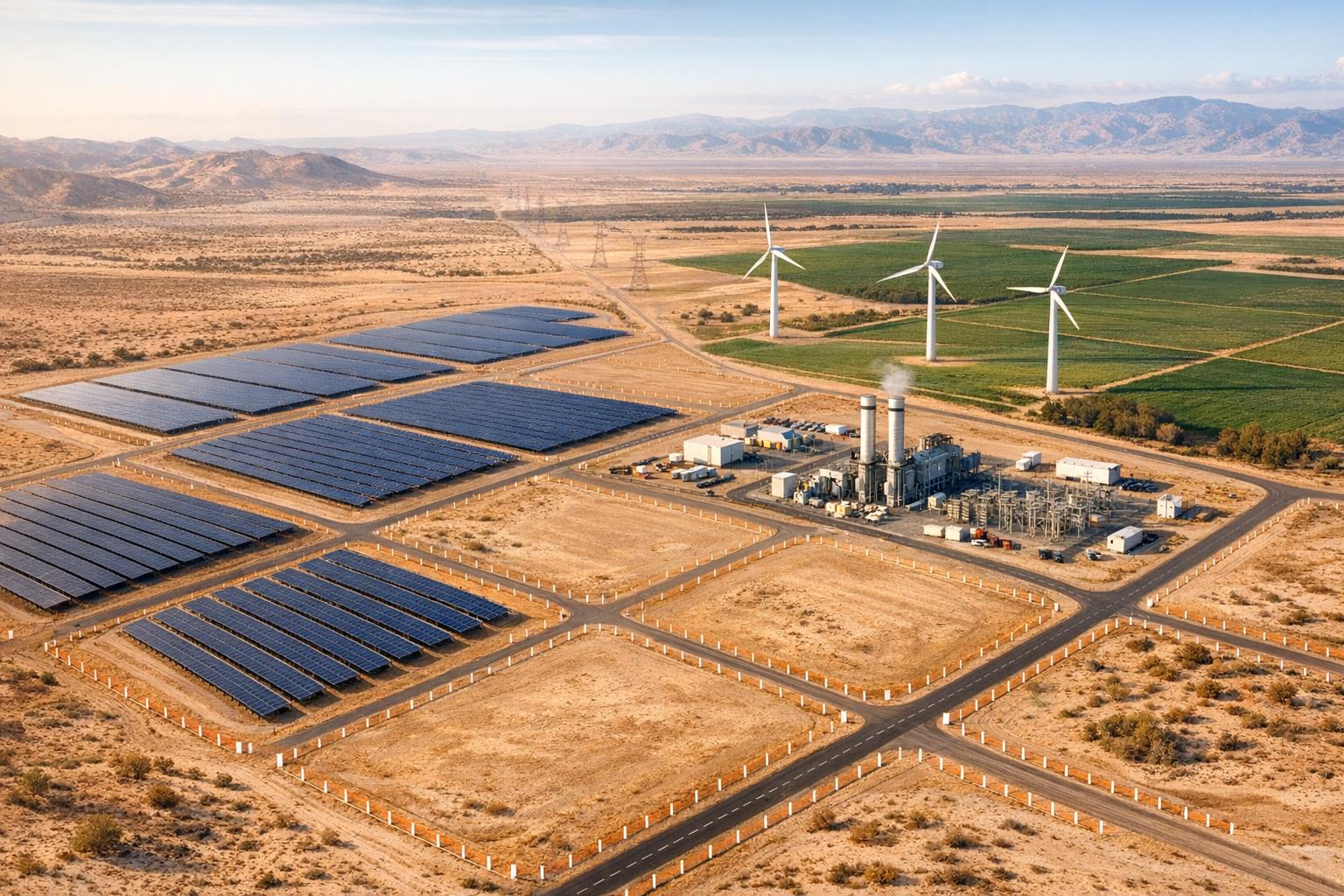
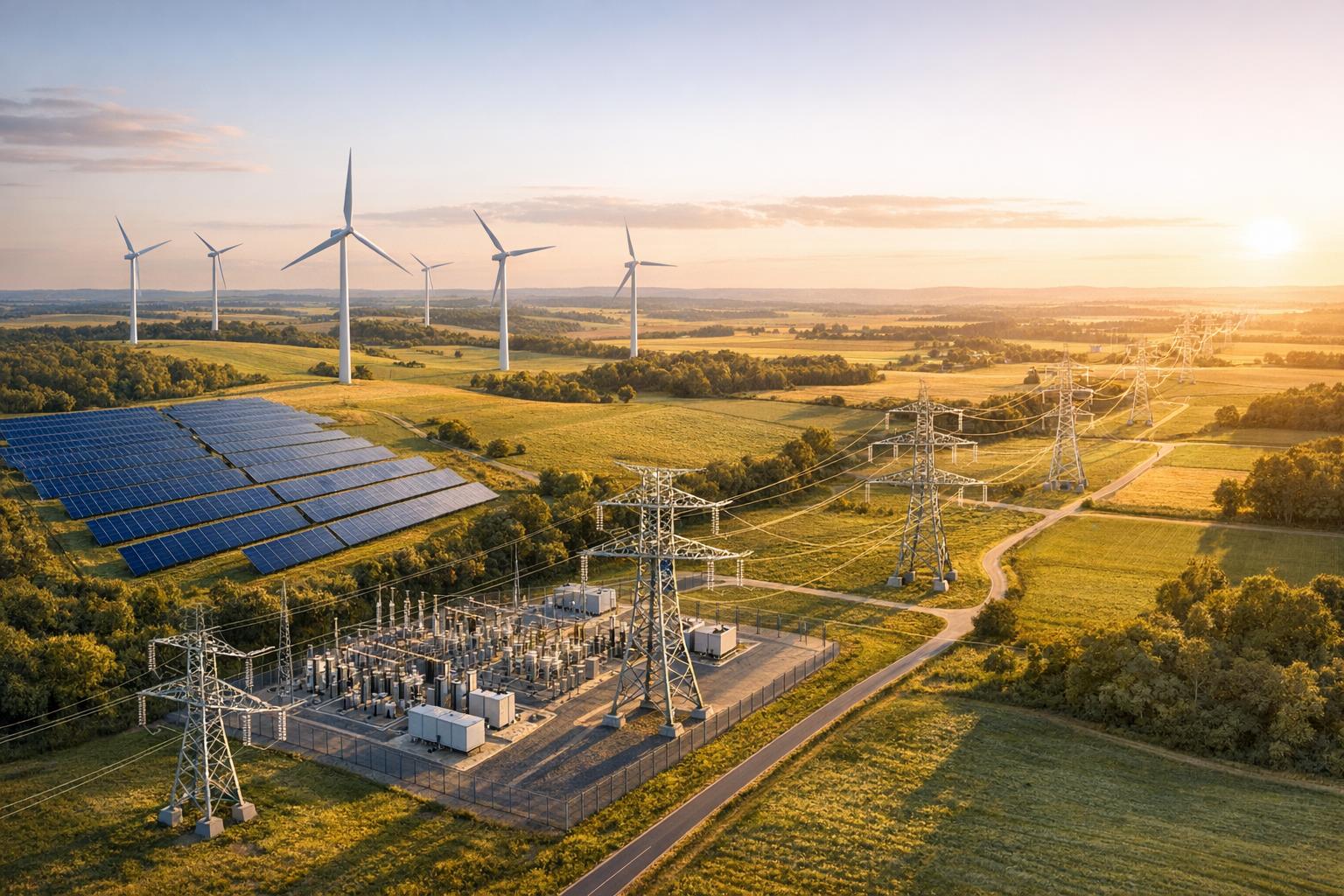
Energy infrastructure investments are becoming increasingly important for financial growth, especially with the rapid expansion of renewable energy and data centres. Key strategies to maximise returns include:
- Investing in large renewable energy projects like solar and wind farms, which offer steady financial returns and long-term cost savings.
- Improving energy efficiency in data centres through advanced cooling technologies and AI-driven systems to reduce electricity consumption and operational costs.
- Using tailored financing models to manage risks and secure funding, such as SPVs, green bonds, and blended finance.
- Adopting predictive maintenance with AI and IoT tools to prevent equipment failures, reduce downtime, and increase asset lifespan.
- Forming partnerships and joint ventures to pool resources, streamline operations, and address challenges like grid delays.
These approaches focus on aligning energy generation, transmission, and consumption, ensuring steady financial performance while addressing regional challenges like grid constraints in the UK and "interface risk" in the Middle East. By integrating renewable energy with digital infrastructure and leveraging advanced tools, investors can improve reliability, optimise energy use, and maintain profitability.
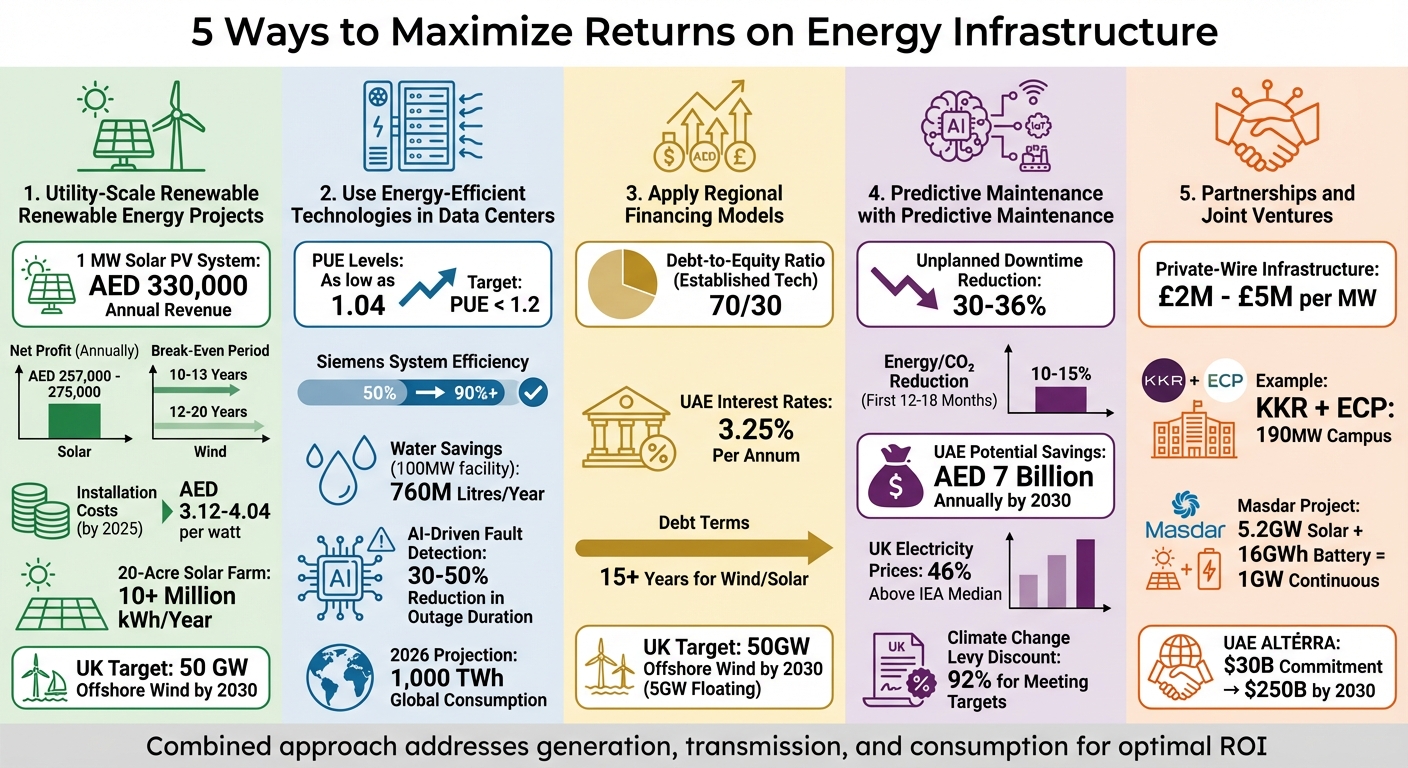
5 Strategies to Maximize Energy Infrastructure Returns: Key Metrics and ROI
1. Invest in Utility-Scale Renewable Energy Projects
Financial ROI Potential
Utility-scale renewable energy projects offer promising financial returns. For instance, a 1 MW solar PV system can generate approximately AED 330,000 annually, with net profits ranging between AED 257,000 and AED 275,000 after covering expenses. These systems typically break even within 10–13 years, while wind turbines take slightly longer, around 12–20 years, depending on maintenance needs and energy output.
In the UK, the Contracts for Difference (CfD) scheme ensures long-term price stability by offering predetermined strike prices, reducing revenue volatility for developers. Installation costs for utility-scale solar are becoming more competitive, projected to fall between AED 3.12 and AED 4.04 per watt by 2025. Wind energy also benefits from relatively low ongoing costs, with operation and maintenance expenses averaging just 1–2 cents per kilowatt-hour. To put this into perspective, a 20-acre solar farm can generate over 10 million kWh annually, while a 100-acre farm produces around 50 million kWh. These figures highlight the strong financial potential for large-scale renewable projects.
Scalability and Adaptability to Regional Market Conditions
Countries like the UK are making ambitious strides, aiming to deploy 50 GW of offshore wind capacity by 2030, including 5 GW from floating offshore wind farms. To tackle grid connection challenges, developers are integrating renewable energy generation with high-demand facilities, such as data centres. Additionally, regional incentives significantly boost profitability. For example, UK operators who meet specific efficiency targets can enjoy a 92% discount on electricity Climate Change Levy charges.
Developers looking to participate in CfD auctions are encouraged to align their projects with the Department for Energy Security and Net Zero's cost assumptions. In the Middle East, resources like the World Bank's guidebooks provide detailed strategies for financing and managing utility-scale solar projects. These scalable initiatives not only adapt well to regional challenges but also position developers for long-term success.
Sustainability Impact
Utility-scale renewable energy is a cornerstone for achieving net-zero goals and meeting global mandates like COP28, which calls for tripling renewable energy capacity by 2030. Institutional investors can measure their contributions to renewable energy growth by adopting the Net Zero Investment Framework (NZIF), which helps set clear objectives and targets for infrastructure assets. Moreover, grid-connected solar plants play a critical role in enhancing national energy security and enabling large-scale decarbonisation.
sbb-itb-0a9f22b
Infrastructure, AI & Energy: Navigating the Golden Age of Infrastructure Investing
2. Use Energy-Efficient Technologies in Data Centers
Boosting data center efficiency not only cuts operational costs but also reduces environmental impact, creating a win-win scenario when paired with renewable energy solutions.
Operational Efficiency Improvements
Adopting energy-efficient technologies, such as advanced cooling methods like liquid immersion and direct-to-chip cooling, can significantly ease electricity demands. These innovations have brought Power Usage Effectiveness (PUE) levels down to as low as 1.04.
One standout example is Siemens Energy's closed-loop system, which improved plant efficiency from 50% to over 90%. This system delivers 7°C cooled water to data centers while repurposing waste heat - at temperatures of 36–40°C - for district heating. In water-scarce regions like the UAE, adiabatic-free cooling systems offer a crucial advantage by slashing water consumption. Traditional evaporative cooling for a 100MW data center, for instance, can consume as much as 760 million litres of water annually. These technological advancements not only enhance operational performance but also strengthen the economic viability of data centers.
Financial ROI Potential
The financial benefits of energy efficiency are equally striking. For example, UK industrial electricity prices are 46% higher than the median for International Energy Agency member countries.
Incorporating Battery Energy Storage Systems (BESS) alongside on-site solar PV installations can unlock new revenue opportunities. A prime example is Masdar's project in Abu Dhabi, which combines 5.2GW of solar PV with 16GWh of battery storage to ensure 1GW of renewable energy is available 24/7. Additionally, AI platforms play a pivotal role in reducing costs through predictive maintenance and dynamic demand management. AI-driven fault detection in networks has been shown to cut outage durations by 30–50%.
Sustainability Impact
The sustainability benefits of these measures are undeniable. By 2026, global data center electricity consumption is expected to hit 1,000 TWh. In the UK, data centers could account for 10% of the country's electricity demand by 2050 - equivalent to the energy needs of over 11 million homes.
A notable example of sustainable innovation is the Old Oak and Park Royal Development Corporation project, which secured £36 million in UK government funding in 2025. This initiative uses waste heat from data centers to provide low-carbon heating for over 10,000 homes and 250,000m² of commercial space.
"Data centres individually and collectively have the potential to take a much more dynamic role in the energy market... These may require the sector to reposition itself as prosumer in the energy market."
– Emma Fryer, Associate Director Data Centres, techUK
Achieving a PUE below 1.2 not only minimises environmental impact but also enhances data center valuation and improves access to preferential financing.
3. Apply Financing Models Designed for Regional Markets
Choosing the right financing model is a key step in ensuring strong returns on energy infrastructure investments. Both the Middle East and the UK have developed financing models tailored to their specific market needs and regulatory frameworks. Below, we explore the financial strategies that drive success in these regions.
Tailoring Financing to Regional Conditions
In both regions, project finance plays a central role in funding renewable energy projects. By using Special Purpose Vehicles (SPVs), risks are contained, as repayments are tied solely to the project’s cash flow. Established technologies like wind and solar often benefit from a typical debt-to-equity ratio of 70/30. However, emerging technologies, such as battery storage, usually require a higher equity share due to market price uncertainties.
In the UAE, specialised financing solutions address local market challenges. For instance, Emirates Development Bank supports solar contractors by offering receivable finance to help manage long payment cycles. The bank also provides CAPEX financing options for SMEs to install solar panels, with business accounts featuring interest rates of 3.25% per annum to encourage sustainable practices.
Meanwhile, the UK’s financial landscape is shaped by the Green Finance Strategy, which channels both public and private funds toward achieving net-zero targets. This strategy supports bold initiatives like deploying up to 50GW of offshore wind by 2030, including 5GW of floating offshore wind. Financial instruments such as infrastructure funds, private placements, green bonds, and yieldcos are used to generate steady dividend income and attract investment.
Unlocking Financial ROI
Region-specific financing models offer clear financial advantages. For example, renewable energy projects in established sectors like wind and solar often secure debt terms exceeding 15 years, providing long-term financial stability. In emerging markets, blended finance - which combines concessional funds with private capital - helps reduce risks. Tools like first-loss tranches and political risk insurance make these projects more attractive to investors.
Refinancing is another key trend. Once a project is de-risked, developers can refinance by replacing high-cost equity or construction loans with lower-cost debt. This approach reduces overall capital costs while maintaining healthy Debt Service Coverage Ratios. Additionally, conducting sensitivity analyses on factors like interest rate changes, energy price fluctuations, and construction delays ensures projects remain viable under different scenarios.
4. Improve Operations with Predictive Maintenance
Predictive maintenance is a forward-thinking strategy that leverages AI and IoT sensors to monitor equipment in real time, helping operators anticipate and address potential issues before they escalate. This approach is transforming asset management by reducing unexpected failures and aligning maintenance schedules with operational needs. Sensors track key metrics like vibration, temperature, pressure, and power quality across assets such as wind turbines, solar panels, and data centre cooling systems. By shifting from reactive to proactive maintenance, organisations can achieve better financial outcomes, enhanced efficiency, and increased resilience.
Operational Efficiency Improvements
For renewable energy assets, where physical infrastructure often accounts for more than 50% of total investment, identifying problems early can significantly extend the lifespan of equipment and improve overall utilisation.
"Predictive maintenance and condition-based workflows commonly cut ~30–36% of unplanned downtime, lifting throughput and OEE without major capex." – Ombrulla
In the wind energy sector, scheduling maintenance during low-demand periods ensures turbines remain operational when electricity prices are highest. Similarly, data centres utilise AI-driven platforms to dynamically optimise cooling and power usage, achieving Power Usage Effectiveness (PUE) ratings below 1.2 - an industry benchmark for operational excellence. These improvements not only enhance efficiency but also contribute to stronger financial performance.
Financial ROI Potential
Predictive maintenance programmes can deliver tangible financial benefits. Within the first 12–18 months of implementation, facilities often see a 10–15% reduction in energy use and CO₂ emissions per unit. In the UAE, where expanding renewable energy could save AED 7 billion annually by 2030 through reduced fossil fuel reliance, predictive systems amplify these savings by minimising unplanned interventions and avoiding energy surges.
In the UK, industrial electricity prices are 46% higher than the median for IEA member countries, adding financial pressure to operators. Facilities meeting Climate Change targets can benefit from a 92% discount on the Climate Change Levy (£0.00775 per kWh, rising to £0.00801 per kWh in April 2026), while high-performing assets are valued at a premium. These advantages position predictive maintenance as a smart investment rather than just an operational cost.
Sustainability Impact
The benefits of predictive maintenance extend beyond cost savings. By preventing equipment failures and optimising energy consumption, facilities can lower their environmental impact while boosting grid reliability. For example, data centres equipped with Battery Energy Storage Systems (BESS) and predictive analytics can stabilise the grid by releasing stored energy during peak demand and providing frequency response services. This dual capability not only supports sustainability goals but also strengthens the role of infrastructure in the shift toward cleaner energy systems.
5. Form Partnerships and Joint Ventures
Strategic partnerships and joint ventures can significantly enhance operational efficiency and financial returns, especially when combined with predictive maintenance strategies. In integrated energy ecosystems, these collaborations simplify financing, construction, and operations, reinforcing a unified approach. By pooling resources and expertise, stakeholders can tackle challenges like equipment shortages or prolonged grid delays. In the Middle East, aligning generation, transmission, and consumption infrastructure demands coordinated efforts across the entire value chain.
Financial ROI Potential
Partnerships open the door to innovative financing models that distribute risk and improve financial returns. Tools like cross-asset guarantees, revenue pooling, and portfolio financing allow investors to align interests across multiple projects rather than treating each asset in isolation. A case in point: In May 2025, KKR and Energy Capital Partners joined forces to develop a 190MW data centre campus. This joint venture combined operational know-how with energy expertise to address grid delays and price volatility.
In the Middle East, sovereign wealth funds have stepped into the role of "system orchestrators", taking on early-stage risks and ensuring that solar farms, transmission lines, and data centres are developed in sync. This coordinated approach mitigates costly delays, especially when dealing with long lead times for critical components like transformers, cables, and turbines - some of which now exceed two years. By adopting these innovative financing models, stakeholders can better manage risks while enabling scalable growth.
Scalability and Regional Adaptation
Collaborative efforts enable projects to scale more effectively by addressing specific regional challenges. For instance, in the UK, buyers' alliances aggregate energy demand to secure better Power Purchase Agreement (PPA) terms. Additionally, upcoming regulatory reforms are expected to favour projects built on strong partnerships. Private-wire infrastructure projects, which often require significant capital investments ranging from £2 million to £5 million per MW, benefit greatly from joint ventures that share the financial load.
"The winners will create system orchestrators – players that are able to look across the entire ecosystem and step in, financially or with decision-making authority, to manage timelines, create shared commissioning schedules, and to ensure every part of the value chain moves in sync." – Danny Touma and Damian McNair, Partners, Energy Transition, PwC Middle East
In the UAE, partnerships are driving ambitious projects like Masdar's 5.2GW solar PV and 16GWh battery storage initiative. This project will deliver a continuous supply of 1GW of renewable energy to the grid, supporting regional data centres. Additionally, the UAE's ALTÉRRA initiative, launched during COP28 with a $30 billion commitment, aims to mobilise $250 billion globally by 2030, showcasing how sovereign-backed collaborations can accelerate large-scale climate solutions.
Boosting Operational Efficiency
Joint ventures also enhance operational performance by integrating complementary skills and resources. For example, co-locating data centres with renewable energy sources improves power reliability and reduces transmission losses. Partnerships with Export Credit Agencies help secure supplier commitments for essential equipment. Moreover, alliances between infrastructure investors and energy producers are transforming energy infrastructure into dynamic platforms rather than static real estate assets. By leveraging shared AI and machine learning tools, these partnerships optimise energy usage, improve efficiency, and support net-zero goals.
Conclusion
The five strategies discussed in this article provide a solid framework for boosting returns on energy infrastructure while aligning with environmental goals. Large-scale renewable energy projects lay the groundwork for cleaner power generation, while energy-efficient data centre technologies help keep consumption under control. Regional financing models make capital more accessible and spread risks, predictive maintenance ensures reliable operations, and strategic partnerships streamline the value chain to avoid costly delays. Together, these approaches tackle the key challenges faced across different markets.
However, challenges like grid connectivity and project delivery persist. By merging renewable energy with digital infrastructure and advanced tools like AI, operators can address issues like energy intermittency, enhance power reliability, and optimise energy usage - all while staying financially sustainable.
"The primary driver of rising electricity demand is the convergence of energy and digital infrastructure in the private sector, rather than by government policy." – IFM Investors
Tailored regional strategies further amplify the effectiveness of these approaches. For instance, sovereign-backed initiatives in the UAE and strategic measures in the UK offer unique advantages. In the UK, operators can take advantage of Climate Change Agreements to cut operational expenses, particularly as the Climate Change Levy is set to increase to £0.00801 per kWh by April 2026.
FAQs
What are the key financial advantages of investing in large-scale renewable energy projects?
Investing in large-scale renewable energy projects offers a variety of financial advantages. For instance, utility-scale solar and wind projects often promise strong potential returns, while energy-efficient technologies can lead to significant cost savings. On top of that, there are financing models specifically designed for different regional markets, making these investments more accessible.
Moreover, renewable energy investments align with both global and regional sustainability objectives, which can boost a company's long-term profitability and reputation. Embracing renewable energy also helps businesses shield themselves from the volatility of fossil fuel prices, creating a more predictable and stable financial outlook.
How does predictive maintenance enhance the performance and lifespan of energy infrastructure?
Predictive maintenance plays a crucial role in energy infrastructure by spotting potential problems early. This allows for timely repairs, preventing minor issues from turning into expensive failures. As a result, downtime is reduced, operational costs are kept in check, and systems perform at their best during critical times.
By tackling small faults before they grow, predictive maintenance also helps extend the life of equipment, protecting long-term investments in projects such as solar and wind farms. In the UAE, where energy efficiency and innovation are high priorities, this proactive approach boosts reliability and ensures maximum returns on infrastructure investments.
What are the most effective financing models for energy infrastructure projects in the Middle East and the UK?
The Middle East and the UK present a range of financing models crafted to support energy infrastructure projects, catering specifically to the growing demands of renewable energy and data centre developments.
In the UAE, options like green loans, structured project financing, and receivable finance are gaining traction, particularly for renewable energy initiatives. These financing methods often benefit from government backing and support from financial institutions, aiming to promote sustainability while lowering capital costs. Additionally, public-private partnerships and green bonds play a crucial role, aligning with the UAE’s ongoing efforts towards sustainable growth.
Across both regions, hybrid financing models that blend debt and equity are commonly utilised. These approaches help investors manage risks while optimising capital expenses. Furthermore, international partnerships and overseas investments open doors to diverse funding sources, enhancing the potential for higher returns. By leveraging these specialised financing options, energy infrastructure projects can reach new heights of success.